Learn with the tools professional engineers use
Teach and learn water modeling without fighting software. epanet-js needs nothing but a browser, is free for education, and gets students to a working model in minutes.
Teach and learn water modeling without fighting software. epanet-js needs nothing but a browser, is free for education, and gets students to a working model in minutes.
Too often the first week of a modeling course goes to installing software and working around the quirks of a dated interface. Then class time is spent learning how to use the software rather than the fundamentals behind it, and the tool becomes the obstacle instead of the subject.
epanet-js removes that friction. Students open a browser and start modeling, on the same engine the industry runs, so class time goes to the concepts and the craft rather than the setup.
Students and teachers get full access for non-commercial coursework at no cost, with nothing to procure or license before the first class.
No installations, no virtual machines. Every student opens a browser and is drawing a real network and running a simulation within minutes, instead of losing the first lab to setup.
It's the same browser-based tool on every machine, so a demo on your screen looks the same on theirs, whatever hardware they brought to class.
Flow (l/s)
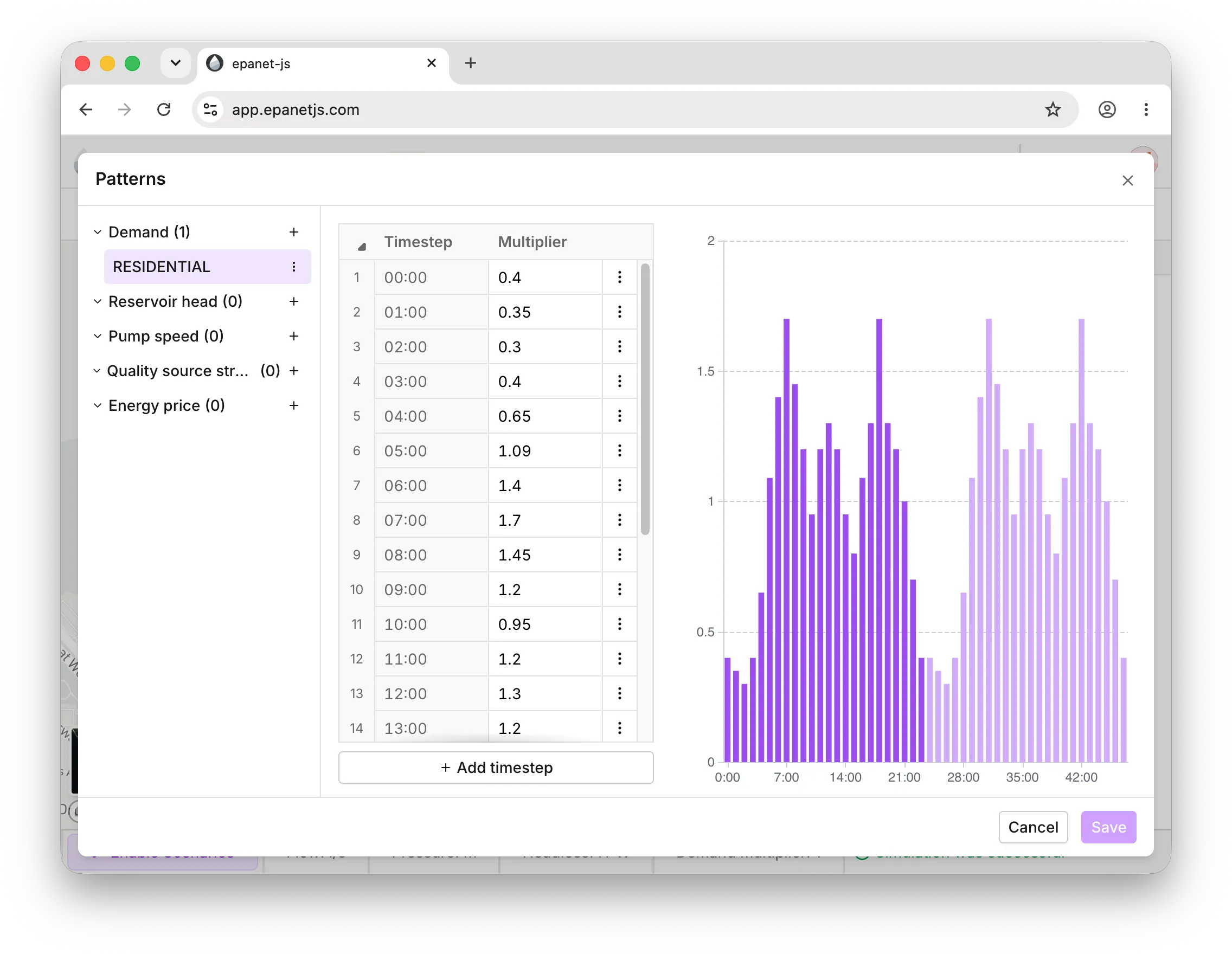
Undo/redo, automatic elevations, and visual map overlays remove the friction that gets in the way of learning. Make mistakes, experiment freely, and build intuition for how water networks actually behave.
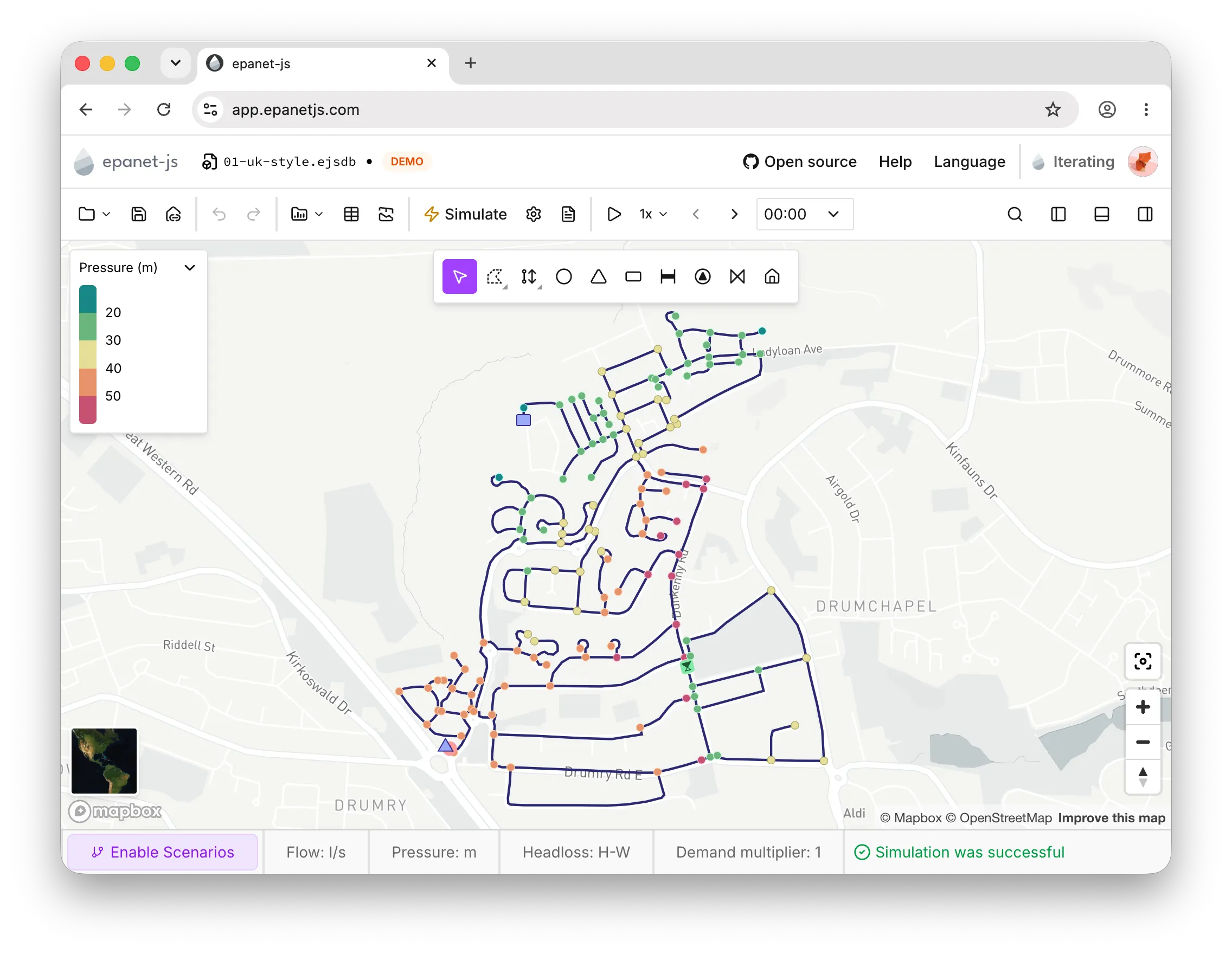
Running a simulation is a keystroke, and the results appear right on the map, so the link between a change and its effect is immediate and visible.
epanet-js runs the EPANET 2.3 engine and works with standard .inp files, so students aren't learning a stripped-down teaching tool. The skills, the workflow, and the standard formats all transfer directly into professional practice.
Graduates arrive at their first job already fluent in a tool the industry uses, not needing to relearn the craft on different software.
Access is free for students and teachers for non-commercial learning and coursework, with eligibility detected automatically from your school email. There are no special forms to fill in for proof of eligibility; your email is your proof.
It's part of the same goal behind the whole project: make good water modeling usable by more people, starting with the ones learning the craft.
Runs in any browser on any OS. No lab installs, no Mac headaches, no IT tickets before week one.
Students draw a real network and run a simulation in minutes — so class time goes to concepts, not setup.
Built on the same EPANET engine the industry uses, so students learn skills that transfer directly to work.
Free access for students and teachers for non-commercial learning and coursework.
Students and teachers get free access. Sign in with your school email to get started.
300+
Students, teachers and researchers in 69 countries model water networks with epanet-js, from lab exercises to full modules.







































































































Workflows students can explore as they learn.
The questions students and educators ask most.
Students and teachers get free access. Sign in with your school email to get started.