Take control of your network and your model
Understand your system, run it better, and keep your data in your hands. epanet-js gives utilities a modern, affordable way to model their networks.
Launch epanet-js
Book a demo No login needed
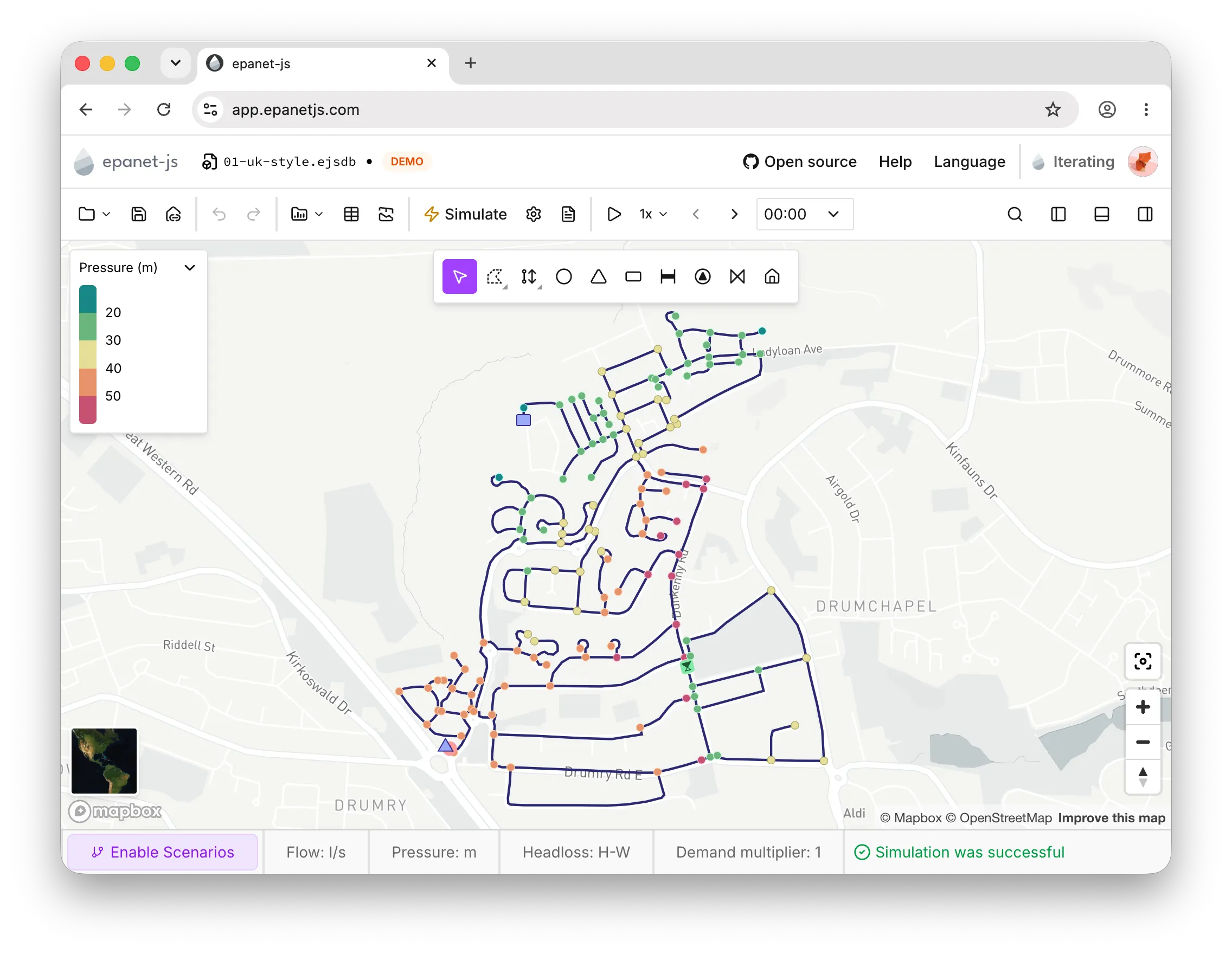
Understand your system, run it better, and keep your data in your hands. epanet-js gives utilities a modern, affordable way to model their networks.
No login needed
Used by water utilities around the world





The utility is responsible for the network every hour of every day, yet the model that represents it often lives inside expensive software, in a proprietary format, on someone else's terms. When the license lapses or the consultant moves on, the understanding can go with it.
epanet-js puts the model back in your hands. It's built on the open EPANET engine, runs and saves your projects entirely on your machine, and is priced to be something a utility team can actually own and use every day, not a once-a-study luxury.
Bring in your GIS and asset data and build a model that mirrors what's actually in the ground. Load your own digital terrain data for elevations, with survey or LiDAR data layered on top and a worldwide source as a fallback. Demand is allocated from your customer records, and the Network Review checks connectivity before you rely on a result.
See pressures, flows, and capacity across your service area, and stop relying on guesswork or out-of-date studies.
A model built in InfoWater Pro, WaterCAD, WaterGEMS, or InfoWorks WS Pro opens in epanet-js as it is, with its scenarios and custom attributes attached, so the work that went into it comes across with the network. EPANET .inp files open too, from version 2.3 back through earlier releases.
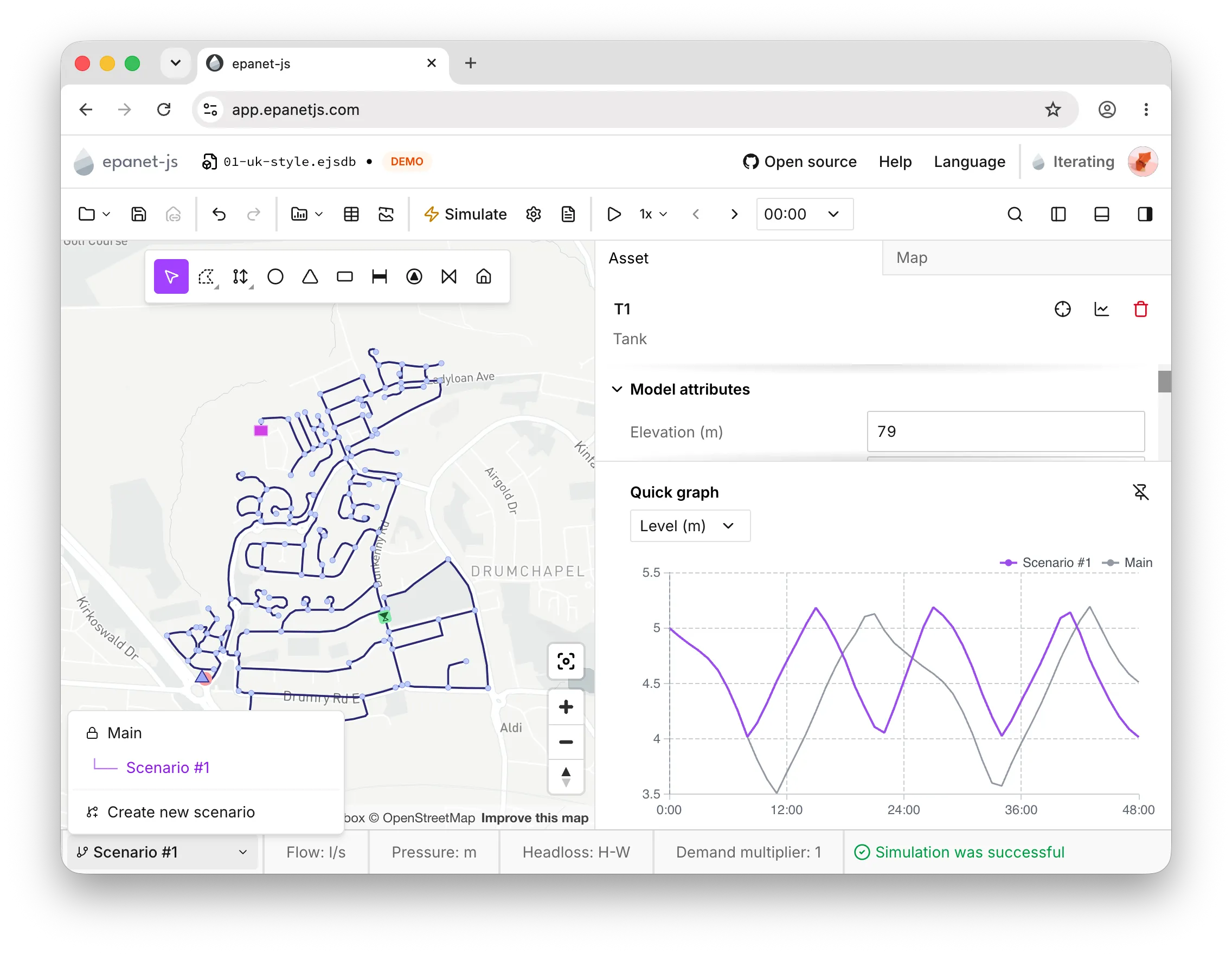
Before taking action in the field, simulate shutdowns, valve operations, and demand changes in the model, and assess fire flow capacity for any development enquiry or hydrant evaluation. Brief your operators with clear, visual answers and reduce the risk of surprises.
Because the work happens against a model you keep current, the answer you give today is one you can reproduce and defend tomorrow.
By default, your projects are created, run, and saved entirely on your machine. Nothing is ever uploaded to our servers, and once the app has loaded you can disconnect from the internet and keep working. Cloud features are entirely opt-in, per project.
For teams with stricter requirements, there are enterprise options: share models through the cloud with your choice of data region, bring your own storage, or run it on-premises inside your own network. The security page covers each setup in detail. The principle behind all of them is simple: the safest data is the data that never leaves your control.
Managed cloud
We run it. Always up to date, zero maintenance.
Chosen data region
Keep data in the region your policies require.
Self-hosted
Run epanet-js entirely on your own infrastructure.
Powered by the trusted EPANET engine, our platform keeps your models fully transparent and free from vendor lock-in. Our codebase is public, and we contribute engine improvements directly back to upstream EPANET so the entire water community benefits.
Build a clear, current picture of how your network behaves under real conditions.
Test operational changes, check capacity, and answer everyday questions with evidence.
Local-first by default — your network data stays on your machine unless you choose otherwise.
EPANET-compatible and affordable. No proprietary formats holding your model hostage.
Launch it free, or book a demo to talk through your utility's needs.
No login needed
The everyday jobs epanet-js helps your team get done.
Turn GIS and asset data into a working model, fast
Build an accurate picture of demand across your network
Assisted tuning that makes your model match the field
Plan your network and investment years ahead
See how your network responds before you make a change
Find available flow and capacity across your network
The questions utility teams ask most about epanet-js.
See epanet-js on your own network. Launch it free, or book a demo to talk through your utility's needs.
No login needed